 Magic Today Photography
In short
From booking timelines to pricing, from rain plans to final delivery, this guide answers the thirty questions couples ask most often. Both sides get a hearing: what couples worry about, and what photographers wish they could say out loud. No padding, no sales talk.
The conversation that started this page
The 11 PM Message That Changed Everything
It was 11 PM on a Tuesday and I was reading the same email for the third time that week. A couple I had met a month earlier wrote: "We love your work. But we have so many questions. Can we just talk?"
Not about price. Not about the album. About everything. How long does it take? What if it rains? Do we need to feed you? Can we negotiate? What happens if we cancel? What if we do not like the photos?
I have had some version of that call more times than I can remember, and the ending is always the same. Couples are not only looking for good pictures. They want to stop worrying.
So I wrote down every question I have been asked across 200+ weddings and answered them plainly. Nothing dressed up, nothing exaggerated. Just what I have seen from both sides of the camera.
Part 1: Booking and Planning (Questions 1 to 8)
Six to twelve months before the wedding date. If you are marrying between November and February, start looking eight to ten months out. Popular dates go first, sometimes more than a year ahead.
Nothing stings more than a call from a lovely couple three weeks before their wedding when my calendar is already full. I once referred a couple to a colleague because they reached out 45 days before their date. Their wedding was beautiful and their photographs were good, but their follow-up emails made it clear they wished they had started earlier.
If you find a photographer whose work you genuinely like, send the enquiry. The worst outcome is hearing "I am booked", and at least then you know.
Stop reading the galleries for a moment and look at the person. By the time you have scrolled through twenty portfolios, every wedding starts to blur into the next one.
What separates photographers is how they make you feel. Do they reply within a day? Do they ask about your story, or push their own ideas? Do they explain things clearly or leave you guessing?
One couple told me they had met three photographers before me. All three showed beautiful work. "You were the only one who asked how we met," they said. That is the difference. You are not hiring a camera. You are hiring a person who will stand beside you on one of the most emotional days of your life.
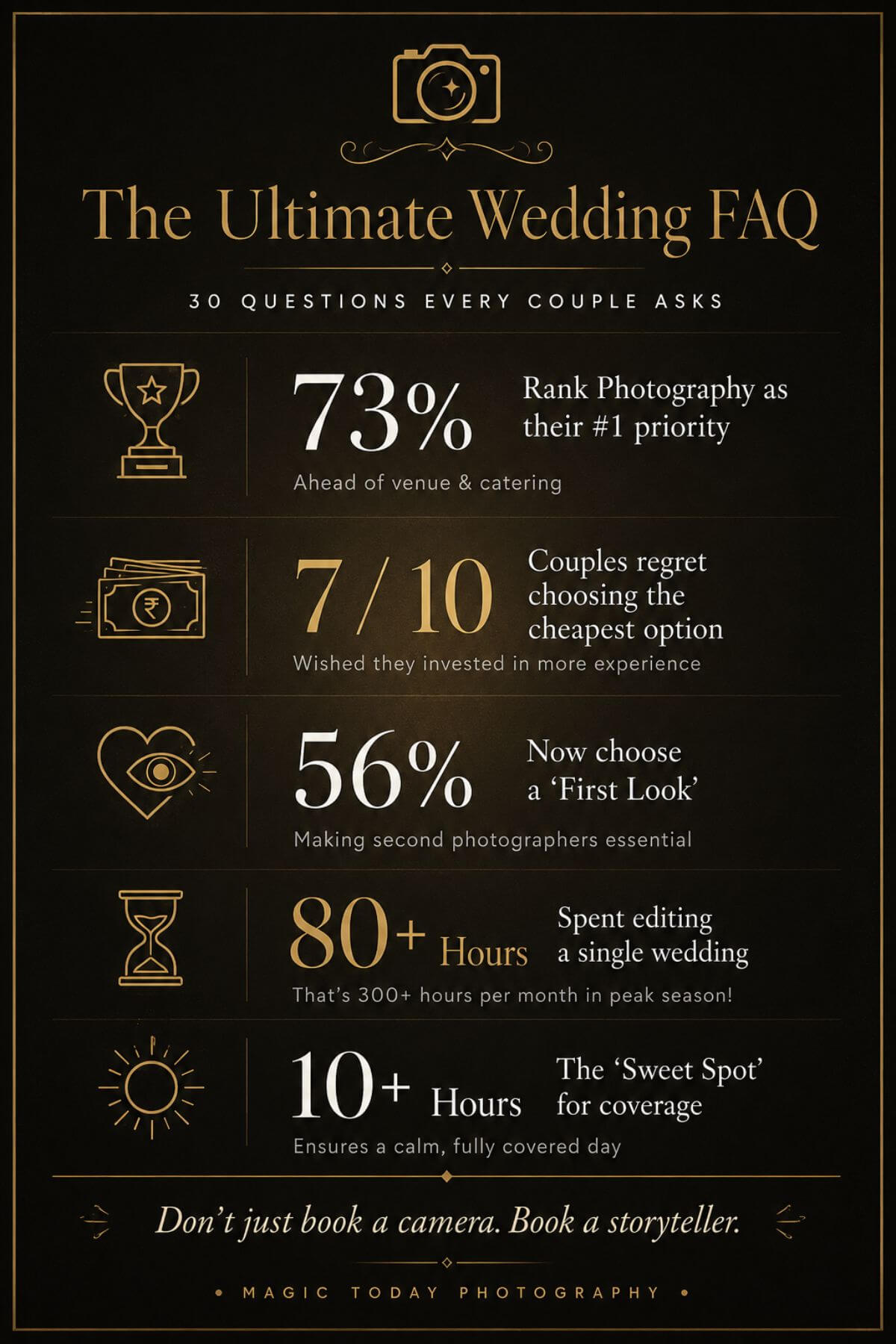
Photography sits at the top of the priority list for roughly 73 percent of couples, ahead of venue, food and entertainment. If it matters that much to you, pick someone who treats it with the same weight.
Ask about style, family photos, backup plans, full galleries, and how they handle a chaotic day. These five cover most of it:
- "Describe your editing style in three words." If the answer is "natural, timeless, authentic", ask to see ten complete galleries rather than the Instagram highlights.
- "How do you handle large Indian family photos?" Be direct: "We have forty combinations to get through. How do you manage that?" A good photographer will describe a system, not shrug.
- "What is your backup plan if you fall ill?" This one matters more than most couples realise.
- "Can we see a full wedding gallery?" The whole thing, start to finish.
- "What do you wish every couple knew before their wedding day?" The answer tells you more about their experience than any portfolio will.
Yes, and not mainly for the photographs. A pre-wedding shoot is a rehearsal. You learn how you look on camera, your photographer learns how the two of you move together, and you find out which poses feel natural and which feel ridiculous.
I can usually tell which couples did one and which did not. The ones who did walk into the wedding day relaxed. They know what to expect and they trust the process. The ones who did not spend the first hour asking "Is this okay?" It is an understandable question, but it slows everything down.
The national average sits near Rs 1.3 lakh, with packages running from about Rs 25,000 to Rs 5,00,000 or more. That range is wide because three things move the number more than anything else: which events you want covered, how many days they run, and which photographer is assigned to you.
A single Muhurtham is priced very differently from a four-day Haldi, Sangeet, Muhurtham and Reception schedule. And within the same studio, an associate photographer, a lead photographer and the founder will all be quoted differently, because the experience and the time each one brings to your wedding are not the same.
Typical ranges by tier
| Tier | Price Range | What You Usually Get |
|---|---|---|
| Budget | Rs 25,000 to Rs 75,000 | One photographer, basic editing, digital delivery |
| Mid-range | Rs 75,000 to Rs 2,50,000 | Lead photographer plus assistant, full editing, online gallery, often a pre-wedding shoot |
| Premium | Rs 2,50,000 to Rs 5,00,000+ | Multiple photographers, cinematic film, albums, extended coverage |
| Luxury | Rs 5,00,000 to Rs 20,00,000+ | Full team, destination travel, multi-day coverage, high-end production |
Indicative ranges by event type
| Event Covered | Typical Coverage | Indicative Range |
|---|---|---|
| Single event (Muhurtham or Reception only) | 6 to 8 hours, one photographer | Rs 40,000 to Rs 90,000 |
| Full wedding day | 10 to 12 hours, lead plus second shooter | Rs 75,000 to Rs 2,50,000 |
| Multi-day Indian wedding (Haldi, Sangeet, Muhurtham, Reception) | Three or more days, larger team | Rs 1,80,000 to Rs 5,00,000+ |
| Destination wedding | Two to three days plus travel | Rs 2,00,000 to Rs 6,00,000+ |
For South Indian weddings, Rs 50,000 to Rs 2,50,000 is typical for a full day of candid coverage.
Those numbers still do not explain why one photographer quotes Rs 50,000 and another quotes Rs 2,50,000 for what looks like the same day. The gap comes from experience, gear that can cost several lakhs, editing time of 50 to 80 hours per wedding, backup systems, insurance, and the weight of being responsible for someone's most important memories.
You can ask, but how you ask changes the answer. A couple tells me they love my work. Then they ask whether I can match another photographer's quote. I want to say yes. I also know what goes into the work: eighty hours of editing, several lakhs of equipment, two hundred weddings of experience. If I discount every enquiry, I do not stay in business, and an out-of-business photographer cannot deliver anyone's album.
From your side, I understand the pressure. Between venue, catering, outfits and a hundred smaller bills, photography can feel like one more line item, and a confusing one at that.
The way through is to change the package rather than the price. Drop the album. Drop the second shooter. Drop the pre-wedding shoot. Keep the coverage of your main ceremony intact and let go of what you can live without.
Seven out of ten couples who booked purely on the lowest quote later wished they had spent more on an experienced photographer.
Everything. The date, hours, deliverables, payment schedule, cancellation policy, and what happens if something goes wrong. A good contract protects both of you. Look for:
- Deposit amount, usually 20 to 50 percent of the total
- Cancellation policy, including how much of the deposit is retained
- Delivery timeline with a clear date or number of weeks
- Number of edited photos, written down rather than assumed
- Overtime rates for when the wedding runs past schedule
- Meal and travel arrangements, with who pays for what
I once worked with a couple who had not read the contract closely. They assumed we would stay for the whole after-party. We had agreed on ten hours. The party ran to 2 AM. I stayed, because I am human and I cared, but it left me exhausted for a shoot the next morning. The contract exists so both sides know where they stand.
If a photographer has no written contract at all, walk away. It leaves you both exposed.
Usually 30 to 50 percent at booking, 30 to 50 percent around the wedding day, and the balance after delivery. A common structure looks like this:
- 30 to 50 percent at booking to hold the date
- 30 to 50 percent on or just before the wedding day
- 10 to 20 percent after delivery, once the final gallery is in your hands
The deposit is not just money. It is a commitment. When I hold your date, I turn away other couples who wanted it. If you cancel at short notice, that income is gone, which is why deposits are usually non-refundable.
Protect yourself as well. Never pay the full amount upfront. Keep some of the payment until you have received your photographs.
Part 2: The Wedding Day (Questions 9 to 18)
Ten hours is the sweet spot for most weddings. Here is how the options break down:
- 6 hours: Smaller weddings, one location, minimal getting-ready needs. You get the ceremony, key portraits and reception highlights, but you miss the full getting-ready story and the late dancing.
- 8 hours: Works for most weddings with 200 to 250 guests. Covers partial getting-ready, the ceremony, family and couple portraits, toasts and the first dance.
- 10 hours: The comfortable choice. A relaxed morning, full getting-ready on both sides, a first look if you want one, golden hour portraits and the full reception.
- 12 hours or more: Needed for Indian weddings with multiple events, including Haldi, Sangeet, Baraat and Vidai.
Ten hours or more is usually where a wedding day starts to feel calm rather than compressed. If your venue is far from the getting-ready location, factor in travel time, because Bangalore traffic can eat into the schedule quickly.
Yes, if you have more than 100 guests or if the two of you are getting ready in different places. A second shooter is not a luxury, it is coverage you cannot get any other way. While I am with the bride, the second photographer is with the groom. While I shoot the ceremony from the front, they catch guest reactions from the back. While I run family portraits, they keep shooting the candid moments around the edges.
Roughly 56 percent of couples now choose a first look before the ceremony. If you are doing one, a second photographer becomes close to essential, because both reactions happen at the same moment.
A first look is a private moment where you see each other before the ceremony. It is not part of most traditional South Indian schedules, but more couples are choosing it.
What works in its favour: you get quiet, intimate photographs without an audience, nerves settle before the ceremony, and couple portraits can happen earlier, freeing up the evening.
What works against it: it breaks with tradition, and some families look forward to the moment at the mandap.
I enjoy shooting first looks because the emotion is unguarded and the photographs always show it. But I also respect the traditional route. If it does not feel right for your family, skip it. A good photographer will capture the emotion either way.
You adapt. Rain often produces better photographs than harsh sun. I have shot through monsoon downpours and 40-degree afternoons. Umbrellas make strong silhouettes. Wet stone and marble give you reflections. The light after rain is soft and even in a way you cannot fake.
That said, if you are planning anything outdoors, keep an indoor backup location ready. Ask your photographer how much experience they have in rain and whether their equipment is weather-sealed. Not every kit is.
If rain is forecast, lean into it. Matching umbrellas. A covered veranda. Some of my favourite frames have come from wet days.
Yes, and it matters more than most couples expect. A bride once told me she had refused meals for her photography team at a five-star venue because each plate cost Rs 6,000 and she did not want to pay for "seven or eight extra people" across several functions.
I understand the arithmetic. Weddings are expensive and every plate adds up, especially when a venue charges vendor meals at the same rate as guest meals.
But your photography team is on its feet for twelve hours carrying heavy equipment, and they work while you eat. A simple meal, even a basic vendor meal, changes the mood and the energy of the whole day.
Ask your venue about vendor meal rates, which are often lower. Put the arrangement in the contract. And if the budget genuinely will not stretch, tell your photographer in advance rather than surprising them on the day. Most of us will understand. Being told upfront is what matters.
Wear what makes you feel like yourself, and avoid busy prints and neon. A few things that consistently work:
- Solid colours photograph more cleanly than heavy patterns
- Pastels and jewel tones hold up well in almost any light
- Skip neon, which bounces odd colour onto skin
- Comfortable shoes matter more than you think, because you will be standing for hours
- Bring a change of outfit if you are shooting outdoors
I have watched couples spend weeks worrying about outfits and then choose something they do not feel comfortable in. The best photographs come when you feel like yourself. If you are uncomfortable, it shows in your shoulders.
Yes for family formals. No for candids. A list helps when forty relatives need to be arranged into twenty-five combinations. Write down every group you want, and keep it to 20 to 25 combinations at most.
For candid coverage, a list works against you. The best moments cannot be scheduled, and a photographer checking boxes is not watching the room.
One practical tip: appoint a family member to round people up during the formal photos. It keeps things moving and saves you from chasing cousins yourself.
The golden hour is roughly the last hour before sunset, and it is the best light you will get all day. It is warm, soft and forgiving. Shadows soften, skin glows, and the colour cannot be recreated at any other time.
The usable window is closer to 45 minutes, which is why photographers guard it carefully. If I am shooting your wedding, I will ask to rearrange the schedule around it. It is worth the small disruption.
Almost everyone is. That is exactly why you hire a professional. Across more than 200 weddings, the number of couples who were completely natural on camera from the first frame is maybe five. Everyone else was nervous, stiff or self-conscious at the start.
What I do is simple. I talk to you. I make you laugh. I give direction without making you feel posed. I set up situations rather than positions, and I give you time to settle.
The pre-wedding shoot is where most of this gets solved. By the time the wedding day arrives, you already know what works.
Yes, and it is worth doing. An unplugged ceremony means asking guests to keep phones and cameras away during the ceremony itself. Three things improve:
- No screens in your photographs, which is the single most common thing that spoils a ceremony frame
- Guests actually watch instead of viewing the moment through a phone
- Better photographs of the two of you, because you are looking at each other and not at a row of lenses
I ask for it whenever a couple is open to the idea. It makes the ceremony better for everyone, including the guests.
Part 3: After the Wedding (Questions 19 to 25)
Three to eight weeks, depending on the photographer and the season. This question frustrates both sides, so here is the honest version.
Editing a wedding takes 50 to 80 hours. That is not an exaggeration. Sorting through thousands of frames, selecting the keepers, colour correcting each one, cropping, retouching, building the gallery, and designing the album if one is included.
Between November and February, many photographers shoot three or four weddings a month. That is 200 to 300 hours of editing in a single month. It is not slowness, it is thoroughness.
From your side, the wait is hard. You have counted down to the wedding, and now there is another wait on top of it. Ask about the delivery timeline before you book, get it written into the contract, and if you need a few images early for thank-you cards, ask whether a small preview gallery is possible within a week.
Usually 500 to 1,000 edited images for a full wedding day. The number depends on hours of coverage and the photographer's working style. Some deliver 300 carefully chosen frames. Others deliver 1,500.
What matters more than the count is whether the photographs are good. Five hundred strong images will serve you better than 1,500 average ones.
Ask the question directly: "How many edited photos do you deliver for a ten-hour wedding?" Then get the answer in writing.
Candid is unposed, traditional is posed, editorial is styled. In practice:
- Candid or documentary: the photographer follows events as they unfold without directing. Best for couples who dislike being in front of a camera.
- Traditional or posed: the photographer positions you deliberately. Best for family formals and classic portraits.
- Editorial or fashion: heavily styled, dramatic and artistic. Best for couples who want a magazine feel.
Most couples today end up with a mix of roughly 80 percent candid work and 20 percent traditional family formals.
Usually not, and there is a good reason. Raw files are unprocessed. They look flat, dull and often unflattering, because they are not meant to be seen. They are the starting point, not the finished photograph.
Handing over raw files is a bit like handing someone a bag of uncooked ingredients and calling it dinner. The editing is part of the work. It is what turns a decent frame into a photograph you want on your wall.
I understand the instinct to want everything, just in case. But what you actually want is the finished set. Some photographers will sell raw files for an extra fee, though most do not, because unfinished work does not represent them fairly.
It varies a great deal, so ask for specifics. Albums range from simple photo books to heavy heirloom volumes. Questions worth asking:
- How many pages? Twenty, forty, eighty?
- What size? 8x10, 10x10 or 12x12?
- What cover material? Leather, fabric or flush mount?
- Who designs it? The photographer or you?
- Is a digital copy included?
If the budget is tight, skip the album and build your own photo book later. It costs less, and you get to design it exactly how you want.
Talk to your photographer, and be specific. This is every photographer's least favourite conversation, but it is a necessary one. If you chose someone whose work you genuinely liked, the odds of disliking the whole set are low. It does happen though, and the fix is almost always in the detail.
What helps:
- Be concrete. "I do not like them" gives nobody anything to work with. "The colours feel too warm" or "I wanted more candid shots of my grandmother" gives your photographer a direction.
- Give them a chance to re-edit. Most photographers will go back over images when the concern is genuine.
- Check the contract. Some photographers include a re-edit clause, and it is worth knowing about before you need it.
I want couples to love their photographs. If they do not, I want to know why, because there is usually something I can do about it.
Usually not. Under Indian copyright law, the photographer owns the copyright. What you receive is a licence to use the photographs for personal purposes.
In practice that means:
- You can print them, post them on social media and use them for thank-you cards
- You cannot resell them, use them commercially, or hand them to other vendors without permission
- The photographer may use them in their portfolio unless you specifically ask them not to
If full copyright matters to you, some photographers will transfer it for an additional fee. Ask before you book rather than after.
Part 4: The Difficult Questions (Questions 26 to 30)
A professional will have a backup plan already in place. This is one of the clearest reasons to hire a professional rather than a friend with a camera. A professional photographer carries insurance, keeps a network of colleagues they can call, works from a contract that protects you, and will refund your deposit if no suitable replacement can be found.
Ask before you book: "What is your backup plan if you fall ill?" If the answer is vague, treat it as a warning sign.
Read the contract first. Most photographers will work with you. Postponements are common, and most studios handle them in one of two ways. If the new date is free, your deposit usually moves across. If you cancel outright, the deposit is typically retained, because other couples were turned away for your original date.
A common cancellation scale looks like this:
- 90 or more days before: around 50 percent of the deposit refunded
- 60 to 89 days before: around 25 percent refunded
- Under 60 days: no refund
The most useful thing you can do is have the conversation early. Photographers are people too, and most will meet you halfway if you are honest and communicative.
You can, but it usually causes more problems than it solves. I have worked weddings where a guest arrived with professional gear and started helping. Here is what happened: they stepped into my frames, they distracted the couple during quiet moments, their flash spoiled shots I had set up, and the couple ended up with two sets of average photographs instead of one strong set.
I am not threatened by a guest with a camera. I am frustrated when that camera gets between me and the moment I was hired to capture.
If you want a friend to photograph your wedding, hire them as your only photographer. Otherwise, ask them to leave the camera at home and enjoy the day.
It is beautiful and it costs more. Budget for travel, stay and meals for the team. Destination packages in India generally run from Rs 1.5 lakh to Rs 3 lakh, and the final figure depends on how many events you want covered, how many days the team is needed, and which photographer is assigned.
Costs that catch couples out:
- Travel and accommodation for the team
- Meals, which can be steep at luxury venues
- Overtime when celebrations run past the agreed hours
- Location permits, which some venues and heritage sites require for professional shoots
Always ask for a written quote that lists every travel-related cost. A vague estimate now becomes an awkward conversation later.
Trust your photographer, stay in the day, and let the photographs take care of themselves. After more than 200 weddings, these are the things I find myself saying most often:
- You will not remember every detail. That is why you hired someone. I will hold the details so you can hold the feeling.
- Something will go wrong. It always does. The cake arrives late, the flowers wilt, someone spills something. None of it matters next to the fact that you are marrying the person you chose.
- Photographs are not about perfect poses. They are about real moments. Laugh, cry, dance and be present. The camera will catch who you actually are.
- Trust the process. I have done this hundreds of times. If I ask you to stand somewhere specific or wait a few minutes for the light, there is a reason.
- This is your day. Not your mother's, not your mother-in-law's. Make the decisions that feel right to the two of you.
Quick Reference: Wedding Photography at a Glance
Key numbers worth knowing before you book
Photography is the top priority for 73 percent of couples. Seven in ten who chose on price alone later wished they had spent more. Fifty-six percent now plan a first look. A full wedding takes 80 or more hours to edit. Ten hours of coverage is where a wedding day stops feeling rushed.
The Other Side of the Lens: When Bargaining and Late Payments Hurt Everyone
What the photographer sees
I once worked with a client who negotiated hard, cutting close to Rs 15,000 off a package that had already been tailored for them. We agreed, trimmed a few extras and adjusted the deliverables. Then the final payment stalled for two months after every edited photograph and film had been delivered. The team had already spent close to three weeks on post-production. Rent, salaries and data storage do not pause.
That experience taught me something worth writing down: transparency has to run both ways. When couples negotiate honestly and pay on time, photographers remember. When photographers are upfront about costs and timelines, couples trust them more. Neither side gets that for free.
What the couple sees
From your side, the pressure is real. Weddings are a storm of expenses, and photography often lands last in the planning queue. Families are sometimes just trying to survive the numbers. I have had couples tell me they felt embarrassed asking for a discount, but they had no choice because the venue had already swallowed the budget.
The lesson is not to stop negotiating. It is to negotiate openly. Ask for a package that drops the services you do not need, rather than squeezing every line item. And honour the payment timeline, because your photographer runs a small business, not a lending service.
Final Thoughts: From a Photographer Who Has Seen It All
I opened this page with a couple who had too many questions. I will close it with this: there is no such thing as too many questions.
The couples who ask, who dig into what they are paying for and who they are hiring, are the ones who end up happiest with their photographs. The photographers who answer honestly, who explain why they charge what they charge, are the ones who keep those couples for life.
So ask everything. The awkward ones. The ones you think you should already know the answer to. Your photographer has heard them all before, and if they are the right photographer for you, they will answer every one with patience and honesty.
At the end of it all, wedding photography is not about the camera. It is about the connection between you and your partner, between you and your photographer, and between the photographs and the memories they hold for decades.
Looking for pre-wedding inspiration?
From beach sunsets to rooftop evenings to studio light, we have put together 15 creative pre-wedding photoshoot ideas that work for real couples, not just for mood boards.
Frequently Asked Questions
Six to twelve months before your wedding date. During peak season, November to February, aim for eight to ten months because popular dates go first.
The national average sits near Rs 1.3 lakh, with packages from roughly Rs 25,000 to Rs 5,00,000 or more. The final price depends on which events you cover, how many days they run, and which photographer is assigned.
Yes. It works as a rehearsal. You get used to being photographed and your photographer learns how the two of you move together, which makes the wedding day far less stiff.
The date, hours of coverage, deliverables, payment schedule, cancellation policy, delivery timeline, number of edited photos, overtime rates, and meal and travel arrangements.
You can ask, but ask to change the package rather than the price. Dropping the album, a second shooter or the pre-wedding shoot lowers the cost while keeping your main ceremony fully covered.
Ten hours suits most weddings. Six hours works for smaller ceremonies, and twelve or more is needed for multi-event Indian weddings covering Haldi, Sangeet, Muhurtham and Reception.
Yes if you have more than 100 guests, if the two of you are getting ready in different places, or if you plan a first look.
You adapt. Rain gives you umbrellas, reflections and soft light that often looks better than harsh sun. Keep an indoor backup location ready and ask your photographer about their gear.
Three to eight weeks, depending on the photographer and the season. Editing a full wedding takes 50 to 80 hours.
Talk to your photographer and be specific about what is not working. Most will re-edit when the concern is genuine, and many contracts include a re-edit clause.
About the author
Sathya is the founder and lead photographer at Magic Today Photography. He has photographed more than 200 South Indian weddings, working in a candid, unscripted style. He believes every wedding has its own rhythm and that his job is to listen for it. Read more
How this guide was checked: every figure and piece of advice here comes from real client conversations, published industry surveys, and more than a decade of combined experience in the South Indian wedding industry.
The Last Frame
Your wedding day will pass in a blur of silk, jasmine and happy tears. The photographs stay. They become the story your children ask about, the proof of a love that started long before they did. Choose a photographer whose work and experience you trust, not the cheapest quote, but the one who makes you feel seen. Once a moment dissolves into memory, it cannot be staged again.
At Magic Today Photography, we do not just take photographs. We build the record you will hold for the rest of your life.
Found this guide useful? You may also like:
Wedding Photography Pricing Breakdown – What You Are Really Paying For
How Much Should You Budget for Wedding Photography?
Sample Wedding Day Photography Timeline – Hour by Hour
What Is Candid Wedding Photography? 10 Real Examples
Top 10 Pre-Wedding Locations in Bangalore – Complete Guide
15 Creative Pre-Wedding Photoshoot Ideas – Beach, Rooftop and Studio
Ready to book your wedding photographer? Let us build a package that respects your budget and your memories.
Book your free consultation